Our Blog

10 Strategies for Enhancing Social Skills Through ABA Therapy
Introduction to ABA Therapy and Social Skills Development
Overview of ABA Therapy as an Evidence-Based Intervention
Applied Behavior Analysis (ABA) therapy is a scientifically supported approach widely used in the United States to support children with autism. It focuses on increasing helpful behaviors and reducing challenges by applying principles of learning and behavior.
Importance of Social Skills Development for Children with Autism
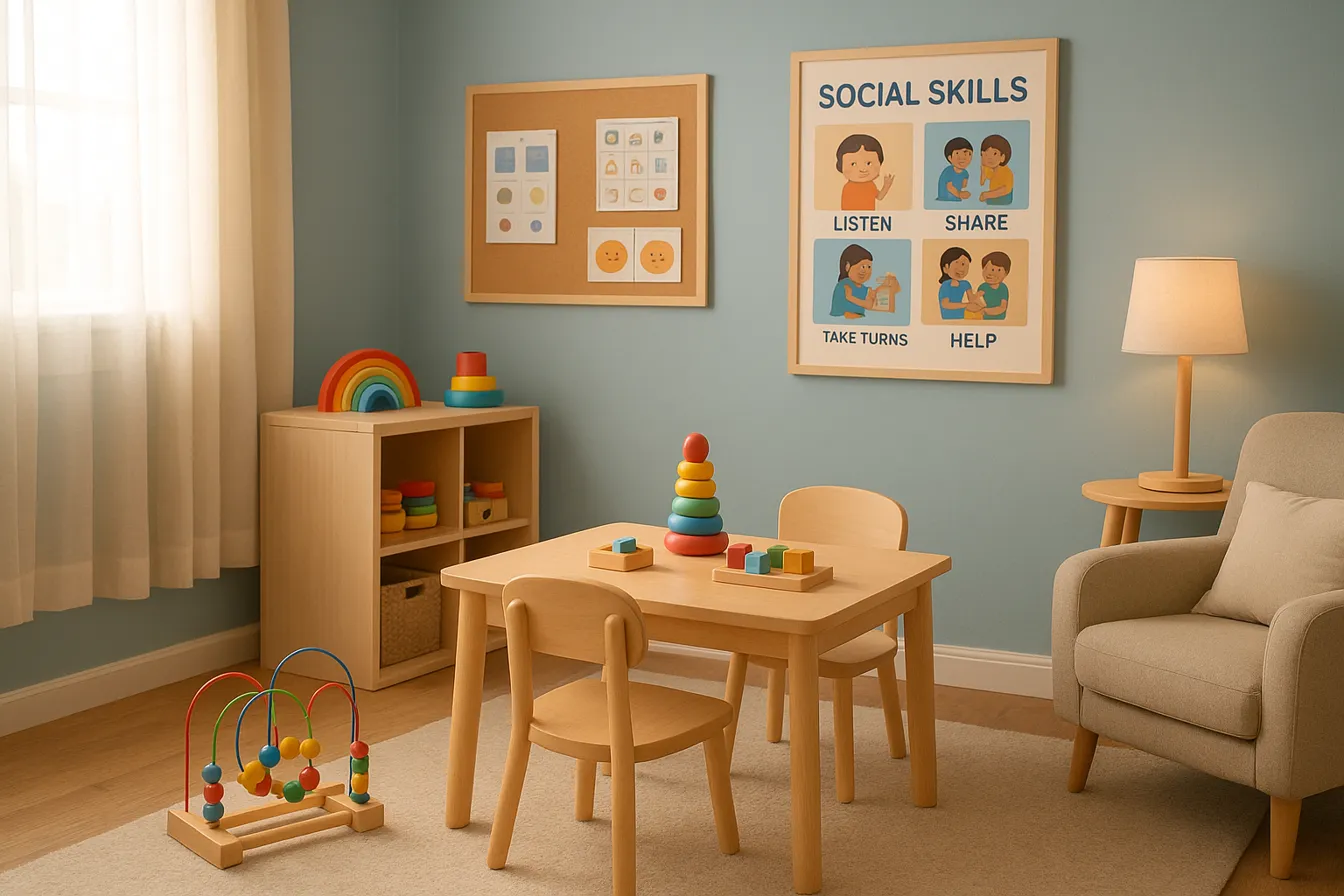
Developing social skills is crucial for children with autism to improve communication, build relationships, and participate more fully in daily life. ABA specifically targets skills like eye contact, turn-taking, sharing, and understanding social cues.
Personalized Approach Tailored to Individual Needs
ABA therapy is highly individualized, with treatment plans crafted to meet each child’s unique strengths and needs. Comprehensive assessments guide the selection of strategies that are most effective for the child’s social development.
Role of Family Involvement and Collaboration
Family participation is integral in ABA therapy. Caregivers are trained and engaged in reinforcing skills at home and in community settings, which helps maintain consistency and promotes generalization of learned behaviors.
Emphasis on Measurable Progress and Generalization Across Settings
ABA therapy uses ongoing data collection to monitor progress objectively. Skills are practiced and encouraged across various environments—school, home, and community—to ensure children apply social skills successfully in real-life situations.
Key Facts on ABA Strategies for Social Skills Development in Autism
- Modeling involves demonstrating social behaviors for children to imitate in various settings.
- Complex behaviors are broken down into smaller steps and practiced through modeling until mastered.
- Modeling is adapted across different environments like home, school, and community for generalization.
- Both therapists and family members play active roles in modeling to reinforce social learning.
- Role-playing provides controlled, safe scenarios to practice social interactions, boosting confidence.
- Social stories utilize personalized narratives and visual cues to teach social norms and expectations.
- Prompting encourages social responses via verbal, gestural, or physical cues, with systematic fading to develop independence.
- Positive reinforcement, including praise and rewards, motivates children to repeat desired behaviors.
- Video modeling uses recorded demonstrations to help children observe and imitate social behaviors effectively.
- Peer-mediated instruction leverages peers as role models and feedback providers to create naturalistic social learning environments.
1. Modeling Desired Social Behaviors for Effective Learning
What strategies can be used with social skills training in ABA therapy?
Modeling is a fundamental strategy in ABA therapy for social skills that involves clearly demonstrating social behaviors for children to imitate. Therapists and family members show specific actions like greeting others, making eye contact, or sharing, providing a consistent and clear example. This repetition helps children understand what behaviors are expected.
How are complex behaviors taught?
Complex social skills are broken down into smaller, manageable steps, making learning easier and more successful. Each step is demonstrated separately through modeling in ABA therapy until the child masters the entire behavior.
How is modeling adapted across different settings?
To ensure skills carry over beyond therapy, modeling social interactions is practiced in various environments such as home, school, or community. This generalization supports the child’s ability to use social behaviors in real-life situations.
What is the role of therapists and family in modeling?
Both therapists and family members actively participate in modeling social interactions. Their consistent demonstration and encouragement create a supportive environment that reinforces learning and aids skill retention.
2. Role-Playing: Practicing Social Scenarios in a Safe Environment

How does ABA therapy improve social skills?
Role-playing for social skills is a vital technique used in Applied Behavior Analysis (ABA) to enhance social skills by providing controlled scenarios where children with autism can practice social interactions safely and without pressure. This method allows children to rehearse behaviors such as turn-taking, sharing, and conflict resolution in a structured setting designed to build both verbal and non-verbal communication.
Providing controlled scenarios for social interaction practice
In role-playing social scenarios, therapists create realistic but controlled social situations tailored to the child's developmental level and individual needs. These opportunities encourage safe experimentation and gradual skill acquisition, helping children understand social expectations and appropriate responses.
Building confidence through rehearsal
By repeating social scenarios in a supportive environment, children grow more comfortable and less anxious about engaging with peers in everyday settings. This confidence translates into a greater willingness to initiate and sustain social interactions beyond therapy. This concept aligns with building confidence through ABA.
Encouraging verbal and non-verbal communication
Role-playing supports both spoken language and body language skills. Children learn when to use eye contact, gestures, facial expressions, and appropriate tone, all crucial elements for effective social communication.
Using role-play to teach turn-taking, sharing, and conflict resolution
Teaching these foundational social skills through role-playing and social stories in ABA helps children master essential cooperative behaviors. Practicing conflict resolution strategies also equips them to handle disagreements constructively, promoting positive peer relationships.
Enhancing competence before real-life application
Role-playing in social skills training serves as a bridge to real-world interaction by preparing children with rehearsed responses and behaviors. This practice increases their ability to navigate diverse social settings successfully and independently.
3. Utilizing Social Stories to Teach Social Norms and Expectations

How does ABA therapy improve social skills?
Applied Behavior Analysis (ABA) uses Using social stories for autism as personalized narratives that help children with autism navigate social challenges effectively. These stories are crafted to address individual needs, focusing on specific social situations that a child may encounter.
Using social stories for autism help children visualize appropriate behaviors by illustrating social cues and norms in an easy-to-understand format. This visualization clarifies what is expected in various social contexts, reducing uncertainty and stress.
By breaking down social interactions into manageable sequences, Using social stories for autism facilitate understanding of social routines and help children anticipate the flow of conversations and events. This sequential approach supports both emotional recognition and empathy, guiding children to better interpret others’ feelings and responses.
Through repeated exposure and Reinforcement in Social Skills Training, Using social stories for autism improve children’s ability to respond appropriately and confidently in diverse social settings, fostering greater social competence and independence.
4. Prompting and Fading: Encouraging Independence in Social Behaviors
What strategies can be used with social skills training in ABA therapy for social skills?
Prompting is a fundamental strategy in ABA therapy for social skills used to encourage social behavior in children with autism. Therapists provide cues—either verbal instructions, gestural signals like pointing, or physical guidance—to initiate social interactions such as greeting someone or taking turns.
Types of prompts: verbal, gestural, physical
- Verbal prompts: Spoken cues or reminders to encourage appropriate social responses.
- Gestural prompts: Non-verbal signals like hand movements or facial expressions.
- Physical prompts: Light touch or hand-over-hand assistance to guide the child.
Systematic fading of prompts to foster autonomy
ABA therapy emphasizes gradually reducing the use of these prompts, a process known as fading. This approach prevents dependence on cues, supporting children in performing social skills independently.
Ensuring gradual transition towards independent skill performance
By carefully adjusting the level of prompting techniques, therapists help children build confidence and autonomy. Transitioning from full physical support to minimal verbal cues encourages mastery without pressure.
Building confidence through scaffolded support
This scaffolded approach ensures children feel supported while progressively taking more control over their social interactions. As independence grows, children feel more confident engaging with peers and adults in various settings. For more on building confidence through ABA strategies, see related resources.
5. Positive Reinforcement: Motivating Social Skill Acquisition
What are effective ABA techniques for autistic children?
Positive reinforcement in Applied Behavior Analysis (ABA) is a cornerstone of ABA therapy that helps children with autism develop social skills by motivating and encouraging the repetition of desirable behaviors. When a child successfully performs a social skill—such as making eye contact, sharing, or taking turns—they immediately receive positive consequences like verbal praise, tokens, or access to a favorite activity. This immediate reward strengthens the likelihood that the child will repeat the behavior in the future.
Using praise, rewards, and tangible incentives
Praise and tangible rewards serve as powerful incentives that make social interactions rewarding for children. By linking specific social behaviors to meaningful positive feedback, children become more motivated to engage socially. For example, if a child maintains eye contact during a conversation, delivering enthusiastic praise or a small reward immediately afterward reinforces that skill.
Encouraging repetition of desired social behaviors
Reinforcement in Social Skills Training encourages children to practice social behaviors repeatedly, which is essential for learning and mastery. Over time, repeated reinforcement leads to stronger habits and confidence in social interactions. This process helps children generalize social skills across different environments and people.
Strengthening motivation and self-esteem
Through consistent positive reinforcement, children with autism gain increased motivation and self-esteem. Each success builds their confidence, promoting independence in social communication and enhancing their overall quality of life.
Applying reinforcement consistently across settings
For social skills to effectively transfer across various situations—such as home, school, and community—reinforcement must be applied consistently by therapists, parents, and caregivers. This consistency ensures that children understand which behaviors are expected and appreciated everywhere they go.
Employing positive reinforcement tied closely to specific behaviors like eye contact and turn-taking transforms social skill training into an encouraging and personalized process. This approach not only supports skill acquisition but also fosters meaningful progress in social development for children with autism.
6. Video Modeling: Leveraging Visual Learning for Social Behaviors

Using videos to demonstrate social skills
Video Modeling in ABA Therapy is a powerful ABA therapy technique that uses recorded videos to demonstrate social behaviors for children with autism. These videos provide clear examples for children to observe and imitate, allowing them to learn complex social interactions more effectively.
Techniques such as self-modeling and point-of-view modeling
Two specialized forms of Video Modeling in ABA Therapy are self-modeling, where children watch videos of themselves successfully performing social behaviors, and point-of-view modeling, which presents scenarios from the child’s visual perspective. Both approaches enhance observational learning by making the content more relatable and engaging.
Allowing repeated viewing for mastery
One significant advantage of Video Modeling in ABA Therapy is that children can view the videos repeatedly at their own pace. This repetition reinforces understanding and supports mastery of social skills by allowing children to revisit and practice behaviors as often as needed.
Supporting non-verbal and verbal skill acquisition
Video Modeling in ABA Therapy is effective for teaching both verbal interactions, like conversational skills, and non-verbal cues, such as facial expressions and body language. By visually representing these behaviors, children gain a better grasp of social communication nuances.
Enhancing understanding through visual representation
Visual learning through Video Modeling in ABA Therapy helps bridge comprehension gaps that might exist with traditional verbal instruction. It offers a concrete, engaging way to understand abstract social cues and expectations, making Social Skills Training in ABA more accessible and effective for children with autism.
Answering the question: What strategies can be used with social skills training in ABA therapy?
Video Modeling in ABA Therapy involves showing children recorded demonstrations of social behaviors, helping them absorb and imitate complex interactions. Variations like self-modeling, where a child watches videos of their own positive behaviors, or point-of-view modeling, emphasize observational learning to improve social understanding and execution.
7. Peer-Mediated Instruction: Naturalistic Social Learning with Peers

Utilizing Peers as Models and Feedback Providers
Peer-mediated instruction involves peers who naturally serve as role models and provide immediate feedback during social interactions. These peers demonstrate appropriate social behaviors such as greetings, turn-taking, and sharing, which children with autism can observe and imitate in authentic contexts.
Promoting Motivating and Inclusive Social Contexts
By integrating peers into the learning process, this approach creates an encouraging environment that feels more engaging and less clinical. The presence of peers fosters motivation and participation, making social learning more enjoyable and meaningful.
Facilitating Natural Social Interactions and Friendships
Peer involvement helps children with autism practice social skills in real-life settings, advancing their ability to build and maintain friendships. This naturalistic learning promotes social competence that extends beyond therapy sessions into everyday life.
Encouraging Immediate Feedback and Reinforcement
Peers provide timely, natural feedback during social exchanges, which can reinforce appropriate behaviors instantly. This real-time reinforcement helps children recognize and adjust their social actions effectively.
Fostering Acceptance and Peer Support
The strategy also encourages acceptance and support from peers, reducing social isolation. Being included in peer groups strengthens social bonds and creates a supportive network, essential for social growth.
What Are Social Skills Strategies for Individuals with Autism?
Peer-mediated instruction is a powerful social skills strategy that engages peers as instructors and supporters. It equips children with autism with authentic social cues and boosts their confidence and competence in social settings through natural, inclusive, and motivating experiences.
8. Discrete Trial Training (DTT): Structuring Social Skill Acquisition
Breaking down social skills into smaller, teachable steps
Discrete Trial Training (DTT) divides complex social behaviors into smaller, manageable components. For example, greeting someone may be broken into steps like making eye contact, saying "hello," and waiting for a response.
Using repeated trials with prompts and reinforcement
Each step is taught through repeated practice trials. Therapists provide prompts or cues to guide the child, then immediately reinforce successful responses with praise or rewards. This consistent reinforcement strengthens the desired behavior.
Ensuring mastery of each component
DTT focuses on mastering one skill component at a time before moving to the next. Careful data collection tracks progress and identifies when a skill is firmly learned, which leads to greater confidence and competence in social interactions.
Applying DTT for skills like greeting and turn-taking
Skills such as initiating greetings, sharing, and taking turns are effectively taught with Discrete Trial Training (DTT). The structured nature of DTT sessions offers predictability and reduces anxiety, allowing children to focus on learning appropriate social behaviors.
Providing predictable and focused learning sessions
DTT uses clear, focused sessions that minimize distractions and deliver instruction consistently. This structured environment helps children with autism absorb social skills in a controlled, effective manner, supporting steady improvement over time.
What strategies can be used with social skills training in ABA therapy?
Discrete Trial Training (DTT) is a structured ABA method that teaches social skills by dividing them into small, manageable steps. Each step is taught systematically through trials with clear prompts, immediate reinforcement, and data collection, ensuring thorough acquisition of specific behaviors such as initiating greetings or sharing.
9. Natural Environment Teaching (NET): Real-World Social Skill Generalization

How does ABA therapy improve social skills?
Natural Environment Teaching (NET) is a vital ABA therapy for children with autism strategy that focuses on teaching social skills within the child's everyday environments such as home, school, and community settings. This approach allows children to practice social interactions naturally during daily routines like playing at the park, shopping, or attending school activities.
NET promotes the use of social skills across diverse environments by integrating the child's personal interests, which boosts engagement and motivation. For example, a child interested in trains might learn to share or take turns while playing with train sets at home or a community center.
By supporting natural social interactions, NET encourages flexibility and adaptability, helping children apply learned behaviors spontaneously in real-world contexts. This enhances long-term retention and practical application of social skills, fostering independence and more meaningful peer relationships.
Family and caregivers are encouraged to reinforce skills in everyday situations, ensuring consistency and generalization of social behaviors beyond therapy sessions. Overall, NET transforms social skills training into functional and naturally occurring experiences that better prepare children for social success in their daily lives.
10. Social Stories and Script Training: Guiding Effective Communication

Using scripts to teach conversational skills
Script training for conversations equips children with autism with predefined dialogues that guide them through social conversations. This method teaches how to initiate, maintain, and appropriately end interactions in a structured and predictable way, fostering smoother communication.
Helping children initiate, maintain, and end conversations
Scripts break down typical conversational components, helping children understand when to speak, listen, or change topics. This step-by-step process builds confidence by reducing uncertainty and increasing their social competence.
Building social narratives tailored to individual needs
Personalized social stories in ABA complement script training by presenting social situations in story form. These narratives reflect the child’s unique social challenges, offering clear examples of expected behaviors and responses to various social cues.
Increasing understanding of social expectations
By using using social stories and scripts, children learn implicit social rules, like greetings, turn-taking, and polite conversation. This clarity improves their ability to navigate social settings with greater independence and awareness.
Enhancing confidence through structured guidance
The repetition and predictability of script training in ABA therapy empower children to practice and internalize social exchanges. This increased mastery often leads to greater self-assurance when engaging with peers and adults alike, supporting ongoing social growth.
Which therapy is the most effective for autistic children?
Effectiveness of ABA Therapy for Autism
Applied Behavior Analysis (ABA) therapy stands out as one of the most effective and evidence-based treatments for children with autism. It systematically improves communication, Developing social skills through ABA therapy , and daily living abilities through structured teaching and reinforcement.
Customization and Family Involvement in ABA
EverCare ABA therapy is highly personalized to meet the unique needs of each child. Collaboration with families is central to the approach, ensuring that treatment plans align with home routines and promote generalization of skills. Family involvement includes training caregivers to reinforce positive behaviors outside therapy sessions.
Scientific Evidence Supporting ABA
Numerous scientific studies support the long-term benefits of ABA for children with autism. The therapy uses proven techniques like Discrete Trial Training (DTT) and Natural Environment Training (NET), backed by decades of research, to foster meaningful improvements.
Importance of Compassionate and Tailored Approaches
Compassionate care with tailored interventions addresses each child’s strengths and challenges. This approach builds confidence, reduces problematic behaviors, and encourages independence, leading to better outcomes.
Role of Trained Professionals Such as BCBAs and RBTs
EverCare ABA therapy is delivered by qualified professionals, including Board Certified Behavior Analysts (BCBAs) who design individualized programs, and Registered Behavior Technicians (RBTs) who implement therapy. Their expertise ensures therapy is effective, ethical, and focused on measurable progress.
Together, these elements make ABA therapy a comprehensive and reliable choice for supporting autistic children’s development and quality of life.
Integrating ABA Strategies to Empower Social Growth
Effective ABA Techniques for Building Social Skills
ABA therapy uses a variety of practical methods to help children with autism improve social interaction. Techniques such as modeling, role-playing, social stories, prompting, video modeling, and peer-mediated instruction allow children to observe, practice, and generalize social behaviors in supportive settings.
Personalized and Evidence-Based Care
Each ABA program is tailored to address the unique needs of the child. Through thorough assessments, therapists develop individualized plans that focus on communication, social skills, and emotional regulation, ensuring interventions are goal-oriented and measurable.
Collaborative Approach Involving Families and Peers
Successful ABA therapy includes active participation from families and peers. Caregivers are trained to reinforce skills at home, while peer involvement promotes natural social learning and inclusion, fostering consistent progress across environments.
Long-Term Benefits and Independence
Over time, ABA therapy cultivates increased social confidence, better peer relationships, and enhanced communication abilities. These gains contribute to greater independence and an improved quality of life.
Encouraging Families to Choose Tailored ABA Services
Families seeking effective support can find compassionate, personalized care through providers like EverCare ABA. Their evidence-based approach and collaborative practices create meaningful progress and lasting partnerships to empower children’s social growth.

Ready To Begin
Get the Support Your Child Truly Deserves
Start your journey with EverCare ABA today. Our team will answer questions, verify insurance, and guide you through every step—so your child can begin thriving with the care they need.